




Inside the $1.7 Billion a16z Bet That Reunites Him With Uber
The headline is real, and for once the number is not inflated. In late July 2026, Travis Kalanick — the pugnacious co-founder ousted from Uber in 2017 — closed a $1.7 billion round for a new venture called Atoms, led by Andreessen Horowitz, with a16z co-founder Ben Horowitz taking a board seat. The deal is confirmed by TechCrunch, SiliconANGLE, Yahoo Finance and others, so this is not a case of conflation or rumor. What is worth unpacking is what Atoms actually is, why the smartest money in the Valley wrote such an enormous check, and the deeply improbable subplot: Uber, the company that forced him out, is now an investor in his comeback.
What Atoms Actually Is
Atoms is less a startup than a rebranded holding company — a corporate roll-up of the empire Kalanick has been quietly assembling since leaving Uber. It stitches together his existing City Storage Systems / CloudKitchens “ghost kitchen” operation and Pronto AI, an autonomous-driving firm Atoms acquired in March 2026, under a single industrial-AI banner.


The company is organized into three divisions, each mapping a slice of the physical economy:
- Atoms Food — the CloudKitchens business and its logistics software, automating commercial kitchens and food production.
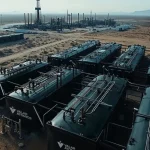
- Atoms Mining — autonomous machinery deployed at extraction sites, built on Pronto’s technology (a ruggedized package of chips, sensors and GPS that automates mining haul trucks). It is run by Anthony Levandowski, the former Google and Uber engineer at the center of the self-driving trade-secrets saga.
- Atoms Transport — described as a “wheelbase for robots,” a general-purpose mobile platform.
Kalanick’s framing is characteristically grandiose. He casts entire industrial sectors as an “atoms-based computer”: manufacturing as the CPU, real estate as storage, transportation as the network. “I started a journey to digitize the physical world,” he said. “Understand, predict and control the physical world with software.” The animating thesis is that the next trillion-dollar computing platform is not another app but the physical economy itself — factories, mines and kitchens run by software and specialized machines.
Why a16z Wrote the Check
Andreessen Horowitz’s involvement is the clearest signal of what this bet really is. It is a wager on “physical AI” — and, pointedly, a contrarian one. While much of Silicon Valley has poured money into humanoid robots (Figure, Tesla’s Optimus, 1X), a16z is backing the opposite philosophy: purpose-built, single-task industrial machines that do one narrow job in one controlled environment, rather than a general-purpose android trying to do everything a human can.


That thesis suits Kalanick’s assets perfectly. A mining truck that drives itself on a private haul road, or a robot that assembles food orders in a windowless kitchen, does not need the crushing engineering complexity of a bipedal humanoid navigating an open world. It needs reliability, uptime and unit economics — the same operational grind Kalanick industrialized at Uber.
The financing structure reinforces the read. The $1.7 billion is not pure venture equity; it blends an a16z-led equity round with substantial debt facilities reportedly arranged through JPMorgan, Goldman Sachs, Bank of America, Wells Fargo and Barclays. Debt on that scale is telling: it is how you fund capital-heavy, asset-owning businesses — real estate, fleets, machinery — not how you fund a pre-revenue software play. Which points to the most important structural fact about Atoms.

The Business Model: Own the Machines, Don’t Sell Them
Atoms is not primarily selling robots. It is buying the operations the robots run inside. Rather than shipping automation hardware to third-party customers, Kalanick is acquiring or building the kitchens, the mines and the transport networks themselves, then automating them and capturing the full margin.
This is a meaningful departure from the standard robotics business, and it echoes the CloudKitchens playbook: buy distressed real estate, subdivide it into automated delivery-only kitchens, and rent to operators. Applied across mining and transport, the model turns Atoms into an operator-owner of physical assets, with AI as the efficiency layer. That is far more capital-intensive than a typical software startup — hence the bank debt — but it is also far more defensible, because the moat is ownership of the physical footprint, not a licensable piece of code.
It is also vintage Kalanick. Uber’s genius was never the app; it was the operational machine underneath it — pricing, dispatch, driver supply, city-by-city market warfare. Atoms is that same instinct pointed at atoms instead of rides.
The Uber Reunion — and the Baggage
The most extraordinary detail is Uber’s participation in the round. The board that pushed Kalanick out in 2017, after a cascade of workplace-culture scandals, is now a shareholder in his return. Kalanick has framed it as “unfinished business,” and the strategic logic is coherent: Uber has spent years trying to crack autonomy and physical logistics, and Atoms is squarely in that lane. The two had previously explored jointly acquiring the U.S. operations of Chinese self-driving firm Pony.ai before those talks collapsed — so the appetite for a Kalanick-Uber realignment predates this deal.
Still, the personnel choices signal that Atoms carries forward Kalanick’s tolerance for controversy as much as his ambition. Handing Atoms Mining to Anthony Levandowski — who was criminally convicted over the theft of Google self-driving files, then pardoned — is not a low-profile hire. It tells you the culture is being built for aggression and speed, not caution.
The Skeptic’s Case
For all the capital and narrative, the hard question is whether Atoms has actually deployed autonomous industrial systems at scale — and here the evidence is thin. Reporting notes sweeping claims and enormous funding, but limited public proof of robots operating in production across these divisions. CloudKitchens itself has faced persistent reports of vacant, struggling facilities, which complicates the tidy “atoms-based computer” story.
There is also a valuation vacuum: no headline valuation was disclosed, which for a round this size usually means the founder had the leverage to keep it private — or that the equity-versus-debt split makes a clean number awkward. Either way, investors are underwriting a vision and an operator’s track record more than a proven, deployed system.
Conclusion
Strip away the cosmology of CPUs and networks, and Atoms is a bet that the person who best industrialized software-driven logistics in the 2010s can do it again for the physical economy in the 2020s — this time owning the assets rather than orchestrating gig workers. a16z’s $1.7 billion, the syndicate of blue-chip banks, and Uber’s reconciliation all point to genuine institutional conviction that “physical AI” is the next platform and that Kalanick is the operator to force it into being. The counter-risk is equally clear: capital and ambition have never been Kalanick’s problem; deployment, culture and trust have. Whether Atoms becomes the operating system for the physical world or an expensively funded holding company still searching for its robots is the question the next few years will answer. But the comeback itself is no longer in doubt.
Sources
- Travis Kalanick’s robotics company raises $1.7B, led by a16z — TechCrunch
- Kalanick raises $1.7B for Atoms, and Uber invests too — The Next Web
- Travis Kalanick’s industrial automation startup Atoms raises $1.7B in funding — SiliconANGLE
- Kalanick’s Atoms raises $1.7B in a16z-led round for industrial AI — Yahoo Finance
- Travis Kalanick raises $1.7 billion for Atoms as a16z bets on specialized industrial robots over humanoids — Startup Fortune
- Engineer who stole 14,000 Google files just landed a piece of Travis Kalanick’s $1.7B robotics empire Atoms — Moneywise
- Kalanick’s Atoms Raised $1.7B to Own the Machines, Not Sell Them — TECHi