



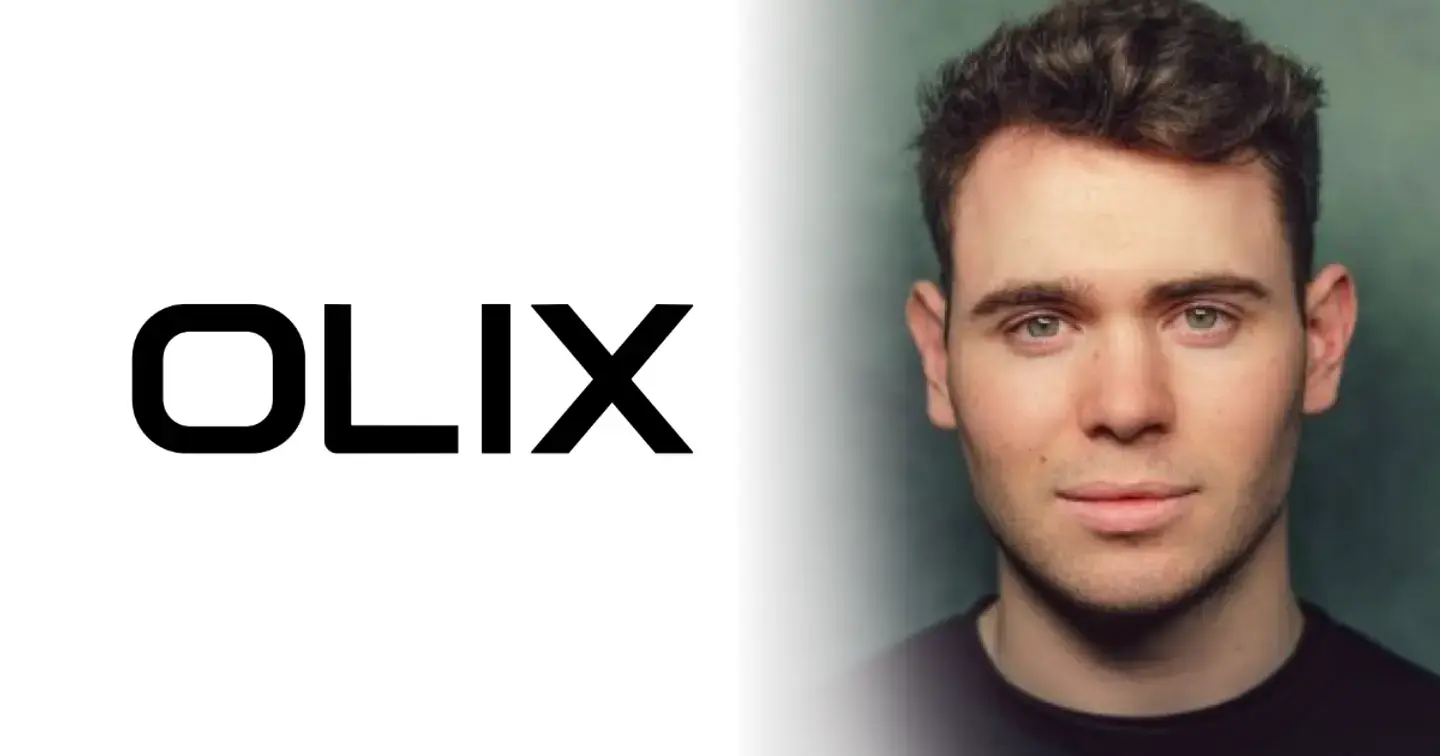
The Optical Bet: Inside OLIX’s €270.5M Raise
Two years is not a long time in the semiconductor business. Chip design cycles routinely run longer than that, and the gap between a promising architecture on a whiteboard and silicon that ships in a data centre is measured in years, not quarters. Yet OLIX, a London-founded AI chip startup that did not exist before 2024, has just closed a €270.5 million Series B round at a €2.8 billion valuation — roughly $312 million and $3.3 billion in dollar terms — making it, by several accounts, the largest chip financing Europe has seen. Remarkably, the company has not shipped a single chip.
The raise is real and well documented, reported by the Financial Times, PitchBook, Data Center Dynamics and others in early August 2026. What makes it worth pausing over is not just the number but the wager behind it: OLIX is betting that the future of AI hardware runs not on copper wires and stacks of expensive memory, but on light.


From Near-Unicorn to €2.8 Billion in Six Months
The trajectory is almost vertical. OLIX raised a $220 million Series A in February 2026 at roughly a $1 billion valuation. Six months later, its Series B tripled that valuation to $3.3 billion (€2.8 billion). For a pre-revenue company, that pace of re-rating is extraordinary — and a sign of how febrile the market for anything resembling a credible Nvidia alternative has become.
The round was led by the investment firm Fundomo, with participation from chip-architecture giant Arm, quantitative trading powerhouse Hudson River Trading, and a roster of existing backers — Hummingbird Ventures, Creandum, Plural, Crane, Phoenix Court and Transition — increasing their commitments. Angel investors include Netflix co-founder Reed Hastings. Crucially, the UK government’s newly created Sovereign AI venture fund also participated, marking one of its first high-profile bets.
That government involvement is telling. AI Minister Kanishka Narayan framed it in strategic terms: “Countries that build chips will build leverage.” Joséphine Kant, who heads ventures for Sovereign AI, said she “left my first meeting with James convinced he’d be one of the most important founders of his generation.” The UK’s calculus is explicit — the global AI-chip market could approach $1 trillion by the early 2030s, and capturing even 5% would represent a roughly $50 billion domestic opportunity.


A 25-Year-Old Founder and a Serious Bench
The “James” in question is James Dacombe, OLIX’s founder, who is 25 years old. He is not, however, a first-time operator: Dacombe previously founded CoMind, a brain-monitoring startup that has itself raised around $100 million. OLIX now employs more than 140 people across the UK, US and Canada, with engineering hubs in London, Bristol, Austin, Toronto and San Francisco.
The company has also assembled a bench that lends the story credibility. Professor Nick McKeown — Stanford professor emeritus, co-inventor of software-defined networking and OpenFlow, 2025 Marconi Prize winner, and founder of Nicira (sold to VMware) and Barefoot Networks (sold to Intel) — has joined the board. As CFO, OLIX hired Matt Briers, who spent nine years as finance chief of Wise and steered it through its £8.75 billion London direct listing. For a two-year-old company, that is an unusually deep roster of networking and public-markets expertise — precisely the disciplines OLIX’s architecture leans on.


The Technology: Ditching HBM, Betting on Photonics
Here is where OLIX diverges sharply from the pack. The company’s pitch, in Dacombe’s framing, is that “a datacenter is a factory whose product is the token,” and that the industry is “moving into a world of specialists.” Rather than build one general-purpose accelerator to rival Nvidia’s GPUs, OLIX is designing a suite of specialised chips, each tuned to a stage of the token-production pipeline.
Its platform is called X-1. The flagship product, the DX-1, is a “decode accelerator” aimed at the reasoning and output-generation stage of large language models — the part that produces tokens one after another. OLIX claims the DX-1 can deliver over 10,000 tokens per second per user on 100-billion-parameter models, scaling toward multi-trillion-parameter deployments.
Two design choices stand out. First, OLIX deliberately avoids high-bandwidth memory (HBM) and advanced packaging — the very components at the centre of today’s supply-chain bottleneck and a key reason Nvidia’s chips are so scarce and expensive. Instead, it relies on on-chip SRAM, an approach reminiscent of Groq and Cerebras. Second, and more distinctively, OLIX connects its chips using a “slow and wide” optical interconnect — photonic links that move data between dies with light rather than copper, promising ultra-low latency and energy cost, and the ability to lash together as many as 10,000 chips in a single multi-rack scale-up domain.
If that works at scale, it addresses two of the industry’s most painful problems at once: dependence on constrained HBM supply, and the power and latency ceilings of electrical interconnects as clusters grow ever larger.
A Crowded, Well-Funded Field
OLIX is entering a fight already populated by heavyweights. Beyond Nvidia — whose CUDA software moat remains the central obstacle for every challenger — there is Etched, valued around $10.3 billion for its bet on transformer-specific ASICs; SambaNova, valued near $11 billion; plus Groq, Cerebras, Graphcore (the earlier British hope, now owned by SoftBank) and inference specialists like Positron. Many of these companies have shipping silicon, real revenue and years of head start.
That context sharpens both the promise and the risk. OLIX’s entire value proposition rests on unproven silicon: its designs are expected to be completed in late 2026, with first customer deliveries not until the second half of 2027. Photonic interconnect at data-centre scale is technically formidable, and the graveyard of AI-chip startups is littered with elegant architectures that never cleared the software-ecosystem and yield hurdles. Being pre-revenue at a €2.8 billion valuation leaves little margin for slippage.
Why This Raise Matters Beyond OLIX
Even accounting for froth, the OLIX round is a meaningful data point. It signals that investors — and a national government — are willing to underwrite a genuinely different hardware thesis rather than another GPU clone, and that Europe is prepared to make a large, concentrated semiconductor bet after years of watching talent and capital drift to the US. Arm’s participation, in particular, suggests strategic rather than purely financial interest from the region’s most important chip franchise.
The strategic logic is sound. AI inference costs are the industry’s next great squeeze, and anything that breaks the HBM chokehold or the copper-interconnect wall has enormous value. Whether OLIX can convert that logic into working, manufacturable, software-supported silicon by 2027 is the open question. For now, the company has bought itself time, talent and roughly €270 million to try. In a market this hungry for alternatives to Nvidia, that may be the scarcest resource of all — but the bill will come due when the first DX-1 chips have to prove themselves in a live rack, not a pitch deck.
Sources
- UK AI chip startup OLIX raises €270.5 million at €2.8 billion valuation just two years after its founding — EU-Startups
- OLIX raises $312m at a $3.3bn valuation and appoints Professor Nick McKeown to its board — OLIX
- Chip startup Olix raises $312m at $3.3bn valuation, backed by UK gov’t Sovereign AI venture fund — Data Center Dynamics
- A 25-year-old just tripled his London chip startup to $3.3bn, betting against Nvidia and the shortage — The Next Web
- Sovereign AI invests in UK startup reinventing AI chips — GOV.UK
- Olix raises Europe’s largest chip round at $3.3B valuation — PitchBook
- Techmeme: London-based AI chip startup Olix raised $312M led by Fundomo, at a $3.3B valuation (Tim Bradshaw/Financial Times)
- Olix Raises $312M for Photonic AI Chip That Ditches HBM: Britain’s Biggest Semiconductor Bet — Tech Times