



The High-School Dropout, the Helium Reactor, and the $1 Billion Bet on Factory-Built Nuclear
When Sequoia Capital led a $1 billion funding round into a three-year-old nuclear startup this month, it did more than mint another energy unicorn. It signaled that Silicon Valley’s most disciplined venture firm now believes the bottleneck on artificial intelligence is not chips or data or talent, but atoms — and that the fastest way to split them at scale may come from a company founded by a 16-year-old high-school dropout with a Manhattan Project great-grandfather.
The round, announced on August 3, 2026, is real, and the headline is accurate: Sequoia Capital led the $1 billion Series B in Valar Atomics, with partner Shaun Maguire taking a board seat. What follows separates the confirmed from the reported, and situates Valar inside the strangest energy gold rush in a generation.


What Is Confirmed — and What Is “Reported”
According to Valar’s own announcement, authored by founder and CEO Isaiah Taylor, the company raised $1 billion in a Series B led by Sequoia, alongside a $200 million credit facility led by Erebor Bank and J.P. Morgan. The named co-investors are a who’s-who of growth and crossover capital: Apandion, Atreides Management, Conviction, Dream Ventures, HOF Capital, Steve Cohen’s Point72, Riot Ventures, Snowpoint Ventures, and Valor Equity Partners.
One number the company itself did not disclose is the valuation. That figure — $6 billion — comes from Bloomberg’s reporting, which TechCrunch and others have echoed. If accurate, it triples the roughly $2 billion valuation Valar reportedly carried after an earlier April 2026 raise, itself following a $450 million round. In other words: a roughly threefold markup in about four months. That pace is worth flagging plainly. It reflects genuine technical milestones, but also the frenzied momentum-pricing that defines this sector right now. Treat the $6 billion as credible reporting rather than a company-confirmed fact.
The Technology: Small, Hot, and Helium-Cooled
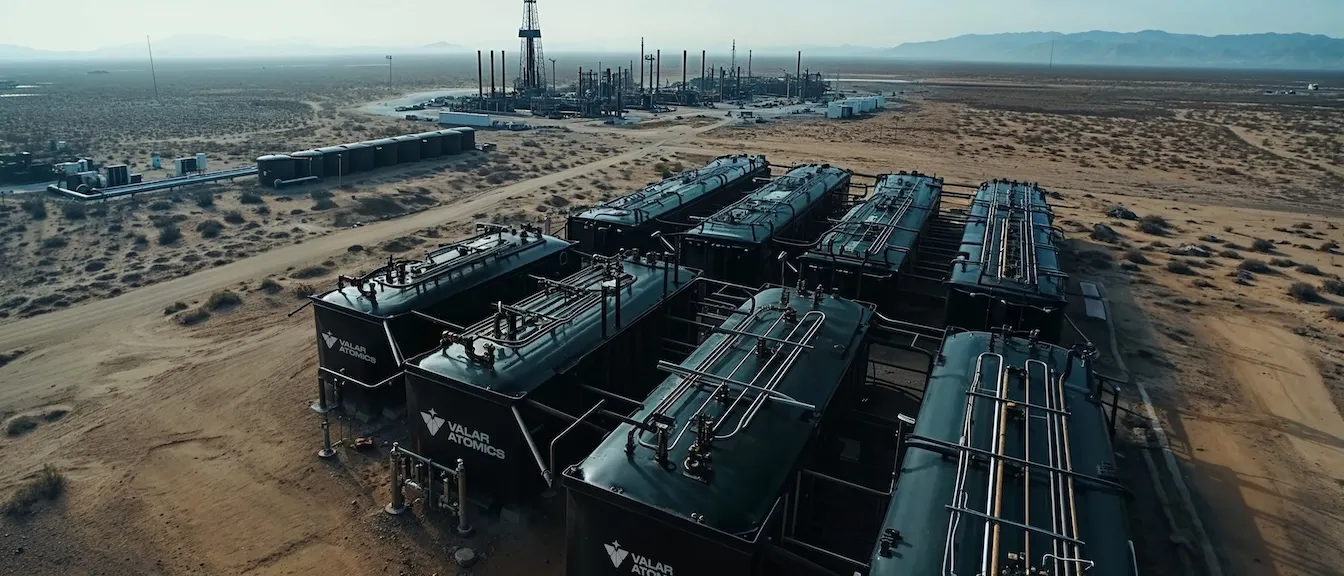
Valar’s core product is the Ward 250, a high-temperature gas-cooled reactor (HTGR) in the microreactor class — a roughly 5-megawatt unit cooled by helium rather than water. That waterless design is not incidental: it is the pitch to AI data-center operators desperate for power in arid regions where water-cooled generation is a non-starter. The company has announced a development deal with Nvidia to build a “waterless 30MW AI factory.”

The reactor runs on TRISO fuel, the robust, poppy-seed-sized fuel form favored by advanced-reactor designers for its resistance to meltdown. Manufacturing TRISO is notoriously hard, and only a handful of domestic suppliers exist — a genuine constraint on Valar’s ambitions, which is precisely why the company intends to make its own.
The technical milestones are the strongest part of Valar’s story, and they are largely verifiable through DOE program records and multiple outlets. The company achieved cold criticality with an experimental “NOVA” core at Los Alamos National Laboratory, claiming to be the first venture-backed startup to split atoms. On June 18, 2026, its Ward 250 prototype reached self-sustaining criticality; roughly a week later, Valar says it used the reactor to directly power an Nvidia Blackwell system — which, if it stands up, would be the first time an advanced reactor has powered AI infrastructure. Components for the Utah build reportedly arrived at Hill Air Force Base via military aircraft in early 2026, and Valar broke ground in Utah in September 2025.


One caveat that cannot be stressed enough: the Ward 250 design has not received Nuclear Regulatory Commission approval. Criticality in a test setting is a research achievement, not a commercial license.
The Real Product Isn’t Electricity — It’s Fuel
Here the story diverges from every other nuclear startup. Taylor has argued publicly that “electricity is a terrible product” because it cannot be stored or transported cheaply. Valar’s long-term vision, as detailed in Contrary Research’s profile, is to use nuclear heat to produce carbon-neutral synthetic hydrocarbons — splitting hydrogen, capturing CO₂, and running Fischer-Tropsch synthesis to make jet fuel, diesel, and gasoline chemically identical to their fossil equivalents.
That reframes Valar’s addressable market from the electricity grid to the roughly $2 trillion global liquid-fuels business, targeting aviation, shipping, and heavy industry. It also explains the company’s signature concept: the “gigasite,” an industrial complex hosting hundreds or thousands of identical small reactors, amortizing licensing and regulatory costs across a fleet rather than a single bespoke plant. The bet is that nuclear’s cost problem is fundamentally a manufacturing problem — that reactors should be stamped out like cars, not erected like cathedrals.
Regulation, Geopolitics, and the Philippines Gambit
Valar’s regulatory footing rests on two federal wins: selection for the Department of Energy’s Reactor Pilot Program (10 companies, August 2025) and its Advanced Nuclear Fuel Line Pilot (four companies, September 2025). These programs, energized under the Trump administration’s push to fast-track nuclear for AI, aim to shortcut a licensing gauntlet that has historically taken a decade or more.
Because U.S. commercial licensing remains slow, Valar is building its first uranium-fueled reactor, “Ward One,” abroad — partnering with the Philippines Nuclear Research Institute under the U.S.–Philippines “123 Agreement” for civil nuclear cooperation. The Philippines’ 7,600 islands, many diesel-dependent, offer both a market and a lighter regulatory path. It is a shrewd, and slightly audacious, way to gather operating data outside the NRC’s orbit.
The Boom That Makes This Rational
Valar is not an outlier; it is the sharp edge of a wave. Venture and public capital is flooding U.S. nuclear as AI data centers strain the grid. Sam Altman-backed Oklo and Amazon-backed X-energy both jumped on reports of selection for a Trump-administration nuclear-for-AI buildout, with X-energy pursuing a multibillion-dollar IPO. Google-backed Kairos Power broke ground on its first Tennessee plant, and Bill Gates’s TerraPower continues construction in Wyoming. Microsoft’s deal to restart Three Mile Island’s undamaged unit remains the emblem of the era.
What distinguishes Valar is its refusal to wait for the traditional utility model. Where Oklo sells power and X-energy sells reactors, Valar wants to sell fuel, own its supply chain end-to-end, and manufacture at volume. That vertical integration is either the masterstroke that cracks nuclear’s cost curve or an overreach that multiplies the ways a young company can stumble.
The Verdict
The confirmed facts are impressive: a genuine $1 billion Sequoia-led round, a real reactor that reached criticality, two DOE pilot selections, and a credible manufacturing thesis. The reported facts — the $6 billion valuation, the tripling in months — should be read as signals of market euphoria as much as intrinsic worth. And the missing facts loom largest: no NRC license, unproven fuel manufacturing at scale, and a synthetic-fuel vision still years from a commercial plant.
Sequoia is not betting that Valar has solved nuclear power. It is betting that in an age when compute is throttled by kilowatts, the company that learns to build reactors like Ford built cars will be worth far more than $6 billion — or nothing at all. Between those outcomes lies the most consequential engineering wager in Silicon Valley today.
Sources
- Sequoia’s Shaun Maguire leads $1B round for nuclear startup Valar Atomics — TechCrunch
- Announcing our $1B Series B Led By Sequoia — Valar Atomics
- Sequoia Leads $1 Billion Investment in Nuclear Startup Valar Atomics — Bloomberg
- A high school dropout’s nuclear startup just landed $1B from Sequoia at a $6B valuation — Tech Funding News
- Microreactor startup Valar Atomics raises $1B — Canary Media
- Report: Valar Atomics Business Breakdown & Founding Story — Contrary Research
- Valar Atomics breaks ground in Utah — ANS / Nuclear Newswire
- Valar Atomics nets funding for HTGR — Nuclear Engineering International
- Trump Administration Taps Oklo, X-Energy to Boost Nuclear for AI Data Centers — Bloomberg
- VC Money Floods Into U.S. Nuclear Startups as AI Power Demand Explodes — OilPrice.com