



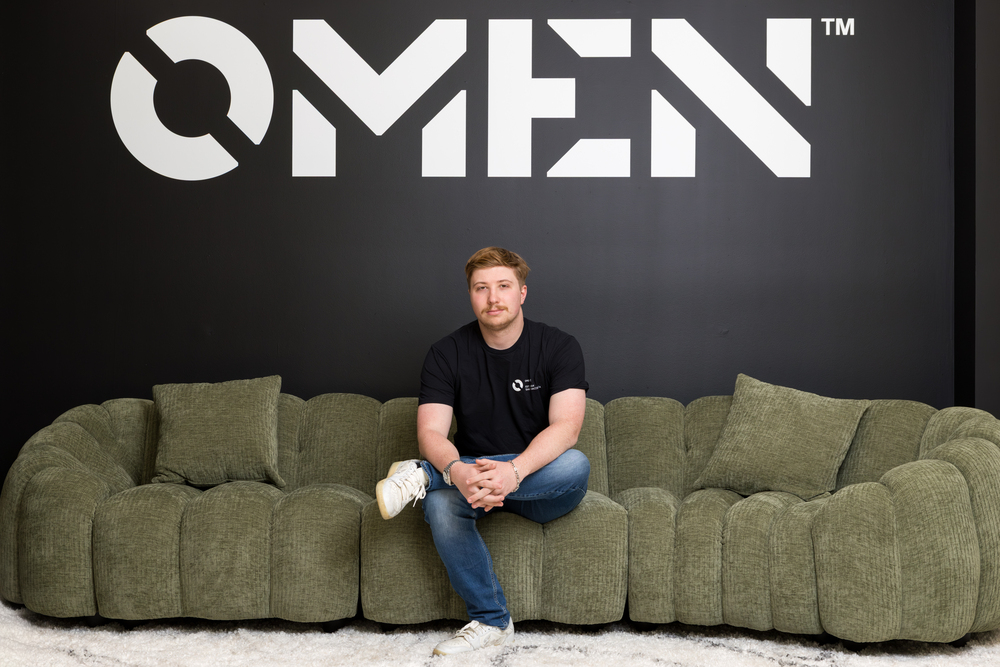
Water Against Downtime: How $31M-Backed Omen AI Wants to Be the “Blood Test” for AI-Era Data Centers
When financial analysts calculate the cost of data center failures, they speak in millions of dollars per hour. When engineers discuss the causes of those failures, the culprit is increasingly not electricity or networking, but fluid — the liters of coolant circulating just millimeters away from the most expensive chips on the planet. It is precisely on this narrow but rapidly growing frontier that the California startup Omen AI has built its business. On June 29, 2026, the company announced a $31 million Series A round. Its pitch is something almost no one had been doing systematically: continuous chemical monitoring of liquid cooling to catch a problem before it becomes a catastrophe.
What Happened: The Facts of the Round
The $31 million Series A was led by Nava Ventures. Joining the round were CRV, Vanderbilt University, the German filtration-systems maker Mann+Hummel, Starhill Holdings, and Hard Launch Capital, along with individual investors — executives from Bridgestone, General Motors, Johnson Controls, and the AI cloud provider TensorWave. According to TechCrunch, this brought Omen AI’s total capital raised to roughly $40 million since its founding in 2024.


The founder’s story is unusual even by Silicon Valley standards. Zach Laberge, the 21-year-old CEO, started his first company at age 14, raising $3 million for sensors used in construction equipment. He dropped out of high school to focus on entrepreneurship. Omen initially worked on fluid monitoring for heavy machinery as well — and it was Caterpillar dealerships, asking for sensor solutions on the “building” side of their operations, that nudged the company toward pivoting into data centers.
How the Technology Works
At the heart of Omen AI’s product is a tiny spectrometer that “reads” the chemical composition of coolant in real time. Instead of drawing a sample every few weeks and shipping it to a lab (with results taking days), the device continuously tracks more than 21 elemental “signatures.”
What does that deliver in practice? The system detects early markers of two distinct classes of problems:


- Biological contamination. Water-based coolant is a breeding ground for bacteria and biofilm. More water in the mix means the liquid absorbs heat more effectively, but the wetter the blend, the higher the likelihood of contamination. A bacterial outbreak can clog the microchannels of cold plates, forcing the operator to shut down and flush the system — a 5-to-6-hour procedure that costs millions.
- Equipment wear. Copper and chromium appearing in the fluid signal pump degradation; silicon points to seal failures. In effect, it is a “blood test” for the cooling loop: from the composition of contaminants, you can diagnose exactly which component is failing — before it actually fails.
Omen offers two deployment formats: permanent sensor arrays connected directly to server-rack fluid systems, and portable diagnostic units for immediate on-site analysis. The company already works with roughly a dozen data center customers, including TensorWave — a “neocloud” building AI compute on AMD chips.
Laberge’s central thesis is simple: “You’re not risking huge amounts of downtime because you have no insight into what’s going on chemically.”


The Bigger Picture: Why Data Centers Got “Flooded”
To understand why such a narrow niche warrants $31 million, you have to look at the thermal physics of modern AI. Just five years ago, a typical server rack drew 5–15 kW, and air cooling handled that heat load beautifully. A rack packed with accelerators like NVIDIA’s GB200 or AMD’s MI300 easily crosses the 100 kW mark. Air simply cannot remove that much heat fast enough — the molecular heat capacity isn’t there.
Hence the industry-wide shift to liquid cooling. There are two main approaches: direct-to-chip (cold plates with circulating fluid pressed directly onto the processor) and immersion (servers fully submerged in a dielectric liquid). Both replace fans and heat sinks with closed hydraulic loops — and in doing so bring all the “joys” of fluid systems into the machine hall: corrosion, deposits, biofilm, leaks, and seal degradation.
The market reacted explosively. According to analyst firms (Mordor Intelligence, MarketsandMarkets, Grand View Research), the data center liquid cooling segment is measured in billions of dollars with double-digit annual growth rates, while forecasts for AI-specific liquid cooling reach $17–18 billion by the mid-2030s. The leaders here are considered to be Vertiv and Schneider Electric — players supplying CDUs (coolant distribution units), cold plates, and complete heat-removal infrastructure.
Where Omen AI Fits In
An important detail: Vertiv, Schneider, and others sell “hardware” — pumps, heat exchangers, distribution units. Omen AI plays in a different layer — the observability layer for the state of the fluid. The analogy is obvious: just as software monitoring tools (Datadog, New Relic) don’t replace servers but watch their “health,” Omen doesn’t replace the cooling system but gives it sensing and diagnostics.
This is a fundamentally different bet. For years, the entire industry invested in getting the fluid delivered to the chip. The question of what condition that fluid is in six months into operation long remained on the margins — “handled” by a manual sample draw once a month. But at densities of 100+ kW per rack, the cost of a missed early signal has risen so high that continuous monitoring is shifting from an option to a necessity.
Omen is not alone here. TechCrunch and industry outlets name adjacent players — Iceotope (which raised $26 million in a Series B in May 2026) and Pyxis Lab. In other words, a new subcategory is taking shape: “fluid intelligence” as a distinct product class. The presence in Omen’s cap table of strategics like Mann+Hummel (filtration) and individuals from Bridgestone, GM, and Johnson Controls shows that the interest extends beyond the pure data center world — these are automotive and industrial fluid-engineering competencies now migrating into AI infrastructure.
Risks and Open Questions
It would be naïve to present this story as an unqualified win. A few caveats.
First, the moat is unproven. Miniature spectrometry and signal processing are not a unique secret; the question is how precisely Omen calibrates its models for different coolant chemistries and whether that holds up when scaling to hundreds of sites.
Second, the founder factor. A 21-year-old CEO with a flashy backstory is simultaneously a marketing asset and a risk for the conservative operators of critical infrastructure, who buy “boring reliability” rather than boldness.
Third, a dozen customers is early stage. The product still has to prove itself at industrial scale, and competitors like Iceotope are moving in parallel.
Conclusion
The Omen AI story is interesting not for the size of the check but for what it highlights: the AI boom is shifting the data center bottleneck from silicon to thermodynamics and chemistry. When a single rack costs as much as a small house and an hour of downtime as much as a team’s annual salary, the market is suddenly willing to pay for what was until recently considered routine maintenance. Omen offers to turn the invisible, slow degradation of fluid into a real-time data stream — and in that sense, it is building not “better cooling” but a new observability layer for the physical body of the AI economy. Whether Omen specifically becomes the category leader remains an open question. But the category of “fluid intelligence” itself appears to have already arrived.
Sources
- Omen AI’s plan to optimize data centers is all wet — TechCrunch
- Omen AI raises $31M to help data centers avoid costly downtime with continuous liquid coolant monitoring — SiliconANGLE
- Omen AI raises $31m to develop fluid monitoring system for data centers — Data Center Dynamics
- Omen AI Raises $31M Series A to Bring Continuous Fluid Intelligence to the Machines Powering the AI Economy — PR Newswire
- Omen AI Raises $31M Series A to Ensure Uptime of AI Data Centers — citybiz
- Data Center Liquid Cooling Market — Mordor Intelligence
- Vertiv and Schneider Electric are Leading Players in the Data Center Liquid Cooling Market — MarketsandMarkets
- AI Datacenter Liquid Cooling Market to Reach USD 17.8 Billion by 2036 — Morningstar/Future Market Insights