



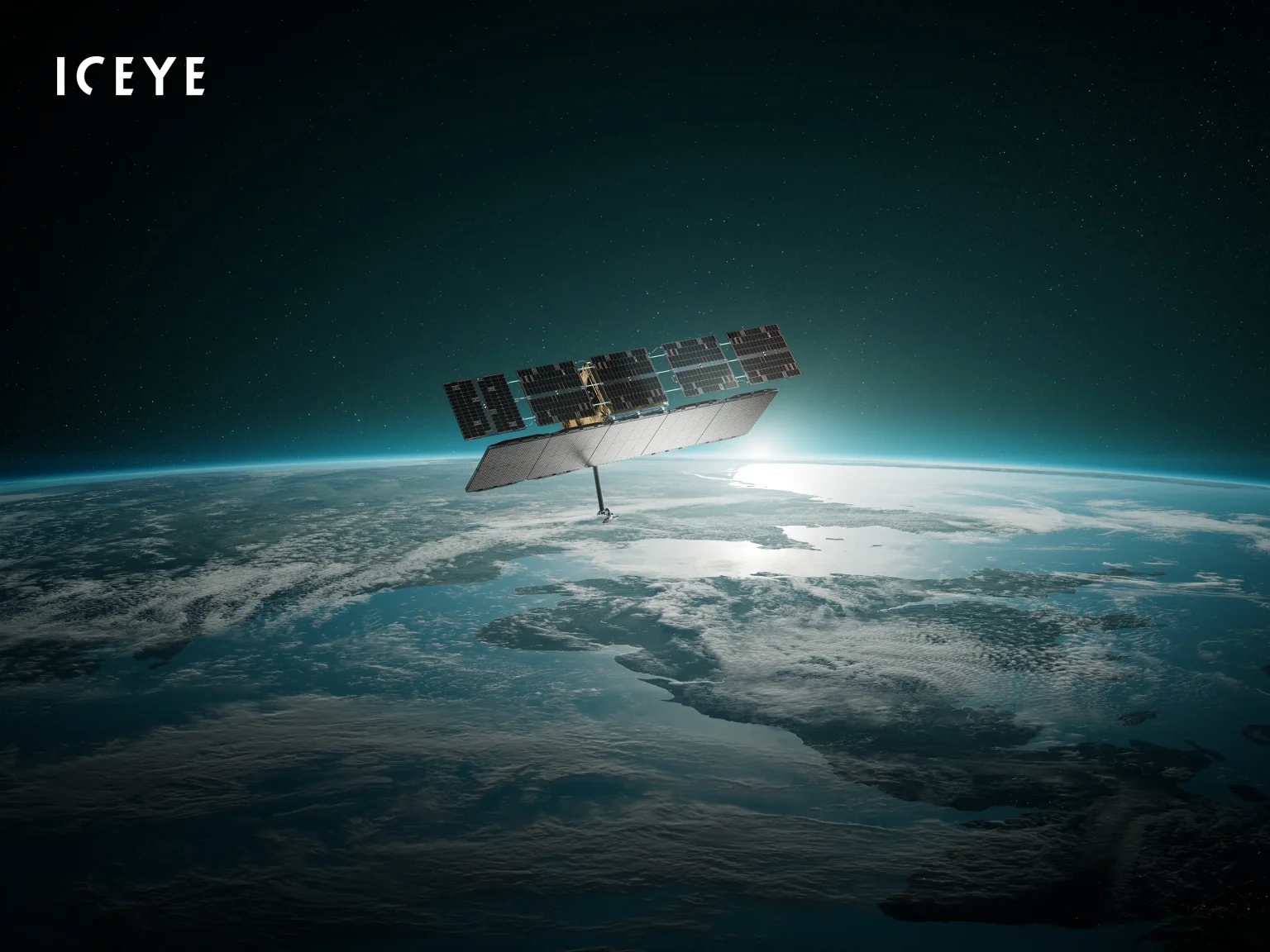
Europe Buys Its Own Eyes in Orbit
Finland’s ICEYE says it has closed a Series F financing round worth more than €1 billion at a valuation exceeding €10 billion — a figure that would make the Espoo-based radar-satellite maker one of Europe’s most valuable private space companies and, by most public accounts, the backer of the largest fundraising round the continent’s space-tech sector has seen. The deal is less a bet on the next SpaceX than a signal of something structural: European governments are moving to own their reconnaissance from orbit rather than rent it.
What Was Actually Announced
The headline number requires a careful reading. According to ICEYE and its lead investor General Atlantic, the round totals over €1 billion, but that figure combines €450 million in primary proceeds — new capital flowing into the company — with a larger secondary component in which existing shareholders sold stock to new investors. The primary raise was first disclosed on 9 June 2026 at a valuation above €10 billion (roughly $12 billion); the expanded, fully-closed round exceeding €1 billion, with the participation of the European Commission-backed Scaleup Europe Fund, was reported in early August 2026.


That distinction matters. A €1 billion round is not the same as €1 billion of fresh operating capital. Still, even the €450 million primary tranche is substantial for European space, and the aggregate deal is what has drawn the “largest European space-tech round” framing. Readers should treat the superlative as widely reported rather than independently audited — a definitive comparative league table was not found in the sources reviewed, so the claim is best understood as reflecting the deal’s scale relative to the continent’s historically thin space financings.
The investor roster is telling. General Atlantic led, with participation from the American growth fund TCV, the Qatar Investment Authority, and strategic investor Nokia, alongside a distinctly Nordic institutional bloc: Finnish state holding company Solidium, state investor Tesi, pension insurers Varma and Ilmarinen, and early backer Lifeline Ventures. The Scaleup Europe Fund — a vehicle managed by EQT with a €5 billion target size, created to close Europe’s late-stage growth-capital gap — made this one of its first investments. The mix of sovereign wealth, state pension money, and public-private growth funds is itself the story.
The Company and Its Technology
ICEYE was founded in 2014 by Rafał Modrzewski, now CEO, and Pekka Laurila, after the pair met at Aalto University. Its bet was on synthetic aperture radar (SAR) rather than optical imaging. Where a conventional camera satellite needs daylight and clear skies, SAR emits its own microwave signals and reconstructs an image from the echoes — meaning it sees through cloud, smoke, and darkness, day or night. That capability is precisely what militaries and disaster responders want and what optical constellations cannot reliably deliver.


The company reached orbit early. On 12 January 2018, ICEYE-X1 became the world’s first SAR satellite weighing under 100 kilograms and Finland’s first commercial satellite — a proof that reconnaissance-grade radar imaging could be miniaturized and mass-produced rather than confined to billion-dollar government birds. ICEYE now says it operates one of the world’s largest and most advanced SAR constellations, has driven image resolution down to 16 centimeters in its latest-generation satellites, and manufactures roughly one satellite a week. It currently produces about 50 satellites a year and aims for 100 annually by 2028.
The financial profile has matured accordingly. ICEYE reported more than €250 million in revenue for 2025, over €100 million in EBITDA — notable profitability for a space company — and a contracted backlog exceeding €1.5 billion.


Why Europe Is Writing the Checks
The through-line of this round is “sovereign intelligence from space.” ICEYE now provides end-to-end sovereign systems — satellites that a customer nation owns and operates itself — to seven European governments, reportedly including Finland, Poland, Spain, Greece, Germany, and Portugal. In a widely-cited proof point, it delivered a fully operational MikroSAR capability to the Polish Armed Forces less than 12 months after contract signing, an unusually fast turnaround for a defense space program. In 2025 it also secured a major Bundeswehr contract reported at around €1.7 billion.
The catalyst behind all of this is the war in Ukraine. Russia’s February 2022 invasion demonstrated that persistent, all-weather orbital reconnaissance is decisive on a modern battlefield, and ICEYE was positioned to supply it. The company has provided the Ukrainian government with access to its SAR constellation, and third-party arrangements have layered on top: Jane’s has reported German government funding channeling ICEYE imagery to Ukraine via Rheinmetall, and ICEYE has said Ukraine expanded its partnership in early 2026 for tactical decision-making. For European defense ministries watching that conflict, the lesson was that renting imagery from a handful of providers — many of them American — is a strategic vulnerability.
The Strategic Backdrop
That anxiety has sharpened as European capitals weigh how dependent they are on U.S. space and intelligence assets at a moment of transatlantic uncertainty. Owning a sovereign SAR capability means a government controls tasking, retains its data, and is not exposed to another country’s export controls or shifting political winds. ICEYE’s pitch — build-and-operate constellations that a nation genuinely controls — maps neatly onto Europe’s broader post-2022 rearmament and its stated ambition for “strategic autonomy.”
The investor base reflects that policy alignment as much as commercial appetite. When national pension funds, a state holding company, an EU-backed growth fund, and a Gulf sovereign wealth fund all crowd into the same round, the transaction is functioning partly as industrial policy. It also fits a pattern flagged by observers such as SpaceNews and European Spaceflight: the buyers of European space intelligence are increasingly governments building their own reconnaissance rather than venture funds chasing a consumer-scale breakout.
What to Watch
The obvious risk is that ICEYE’s fortunes are now tightly coupled to a defense-spending cycle. Backlog of €1.5 billion and profitability provide a cushion, but a demand base concentrated in government procurement is exposed to political and budgetary swings, and scaling to 100 satellites a year by 2028 is an aggressive manufacturing ramp with real execution risk. Competition is intensifying too, from other SAR players and from national programs that may choose to build in-house rather than buy.
Yet the direction of travel is hard to miss. A Finnish company that put the world’s first sub-100-kilogram radar satellite in orbit eight years ago is now a decacorn underwritten by European public money, selling sovereign eyes to a continent that has decided it can no longer afford to look at the world through someone else’s lens. Whether or not the “largest European space-tech round” label survives close scrutiny, the more durable fact is what the money represents: Europe is buying its own eyes in orbit.
Sources
- ICEYE leads a new era of sovereign intelligence from space with €1B funding round — ICEYE
- ICEYE leads a new era of sovereign intelligence from space with €1Bn fundraising round — General Atlantic
- EQT’s Scaleup Europe fund co-leads €1 billion funding round in ICEYE — PR Newswire
- ICEYE secures first Scaleup Europe Fund backing in €1 billion Series F — Defence Industry Europe
- Finland’s ICEYE raises €1 billion at over €10 billion valuation — Tech Startups
- ICEYE’s Bet Pays Off with €10 Billion Valuation — European Spaceflight
- ICEYE raises €1B to expand sovereign space intelligence business — AeroTime
- ICEYE raises €450M at €10B+ valuation — Tech.eu
- History | About us — ICEYE
- ICEYE Provides Ukraine with Access to Its SAR Satellite Constellation — ICEYE
- German government funds Ukrainian satellite imagery through ICEYE and Rheinmetall — Janes
- Iceye raises 1 billion euros to expand SAR satellite systems — SpaceNews